Sinkroll guide: matching dice, chains and Happy Ones

In Sinkroll, connect at least N dice showing N on top: 2 touching 2s, 3 touching 3s, up to 6 touching 6s. They begin sinking. You then have 1 more roll to feed a matching die into the group and extend its chain. A 1 rolled against sinking dice triggers a Happy One, clearing all the 1s on the board.
The chain window is measured in rolls, not a countdown that forces you to react quickly. Think through the follow-up move before spending it.
What counts as a matching group?
A match is a connected group of the same top value, joined along the board’s horizontal or vertical edges. Diagonal contact alone does not connect dice.
| Top value | Minimum connected dice needed |
|---|---|
| 2 | 2 |
| 3 | 3 |
| 4 | 4 |
| 5 | 5 |
| 6 | 6 |
| 1 | Special Happy One rule; not an ordinary 1-die match |
“At least” matters: a connected group can be larger than its minimum. Look for the whole connected group, not only a straight line. An L-shaped group can qualify because its cells are still connected edge to edge.
For example, 3 dice showing 3 in an L shape form a match. The same 3 dice placed only diagonally do not. A pair of 3s is also insufficient until another 3 joins the connected group.
Rolling changes the face on top
The board is 7×7. Moving a die rolls it onto the next cell, changing which face is on top. You are arranging orientations as well as positions.
Suppose a die already shows 3 but sits beside a group you want to complete. Moving it does not preserve that 3 automatically: the arriving face depends on its orientation and roll direction. Use the move preview rather than treating the die like a fixed tile you can slide into place.
A gold preview indicates that the proposed roll will score. For a beginner, this gives you a useful question before each move: am I completing a group, extending a chain, triggering a Happy One or just preparing a future move?
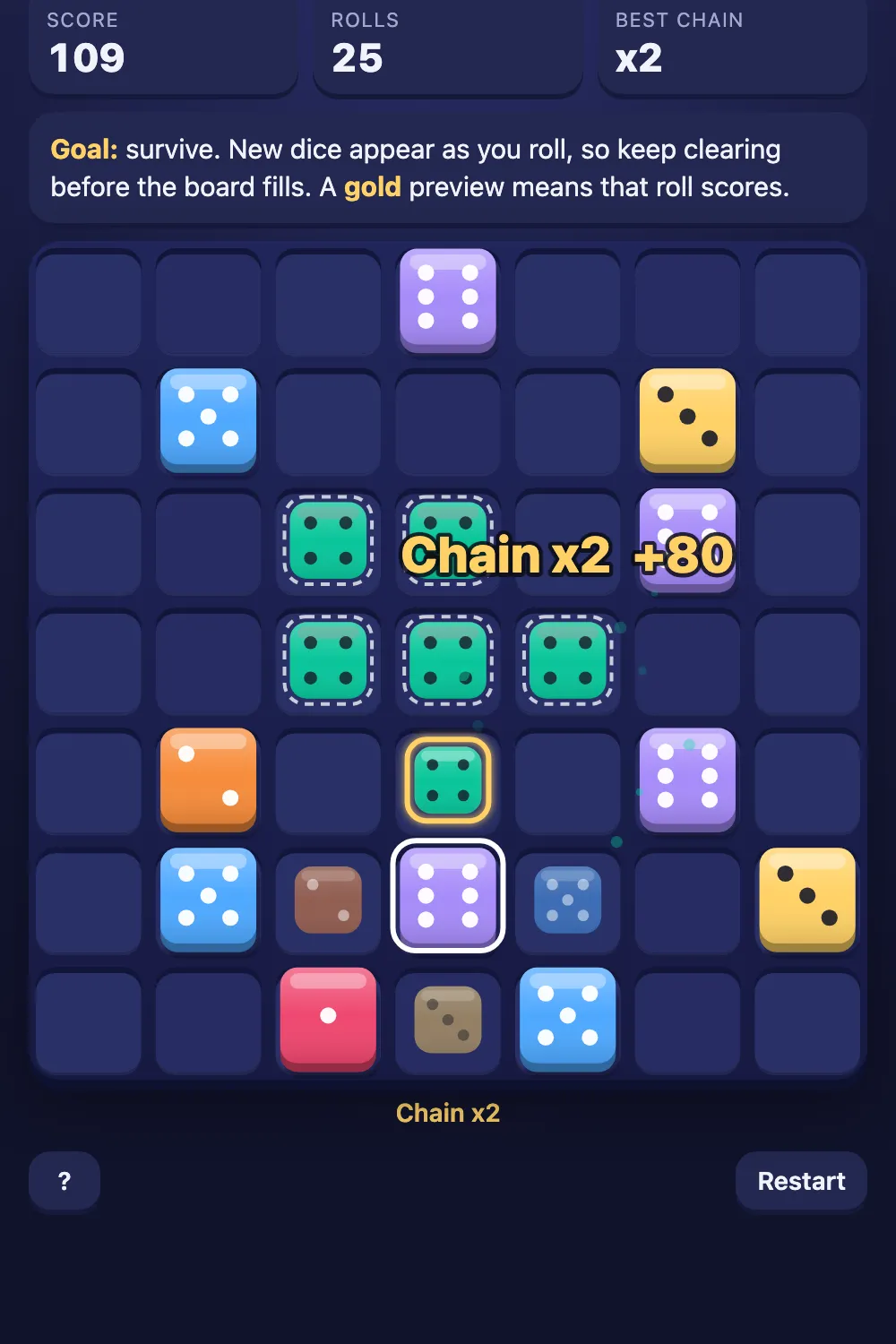
An actual Sinkroll chain. The matching value and the dice’s contact matter; a nearby die with the wrong arriving face will not extend the group.
How chains work, step by step
First make a qualifying group. It begins sinking at chain ×1. Before taking your next roll, look for an unsunk die that can arrive beside that group showing the same value.
If the next roll brings a matching die into contact, it joins the sinking group and increases the chain multiplier. The group remains available for another roll, so you can look for the next extension. If a roll does not refresh that group, the group disappears.
For a simple example, make a connected group of 3s. On the next roll, bring another die alongside it with 3 on top. That creates a ×2 chain. If you then spend a roll elsewhere without extending it, you cannot expect the old 3s to remain available for a later rescue.
You can pause to plan before rolling. The animation is not an instruction to tap faster. The valuable resource is the next move.
What does a Happy One do?
Roll a die so it lands showing 1 beside sinking dice. That triggers a Happy One and sinks every unsunk 1 on the board, including 1s that are not connected to the triggering die.
A lone 1 on an otherwise ordinary square does not clear itself. It needs the contact with a sinking group. The group does not have to consist of 1s—the point is to roll the 1 against dice that are already sinking.
This can make a 1 useful as a follow-up even when it cannot extend the current group’s matching value. Check whether you have a matching-die extension or a Happy One available before using the next roll somewhere unrelated.
Understand the score before chasing large faces
For a newly matched group, the base award is the top value × the number of dice × 10. A group of 3 dice showing 3 therefore starts with 90 points. A larger group of 4 dice showing 3 starts with 120.
When a die joins an existing sinking group, its chain award uses the group’s value × 10 × the new chain multiplier. For example, a die joining a 3-group at ×2 adds 60 points. Other groups or effects on the same roll can contribute more, so the total pop-up can be larger than that single addition.
A 6 is not automatically the best immediate target: it needs more matching dice and may take more preparation. In a crowded board, a reachable small match that opens space can be more useful than chasing a distant large group.
Choose the right mode for learning
Puzzle levels: there are 24 authored levels with defined goals, roll limits and par targets. Read the goal: a chain objective and a score objective ask for different plans. Undo is available in eligible puzzle levels; it is not a universal way to rewind daily or endless play.
Daily board: everyone gets the same daily starting challenge. Watch how your moves affect the available space instead of expecting it to behave like a fixed puzzle with one scripted answer.
Endless mode: new dice arrive as you roll, so space management becomes part of the challenge. Opening cells and preserving routes for useful rolls matter alongside the next score.
A repeatable plan before each roll
- Check whether a sinking group needs its follow-up now.
- Look for a matching extension or a Happy One.
- If no group needs attention, find a nearly complete connected group.
- Inspect the arriving face of the die you want to move.
- Check what space the move opens and what space it uses.
- Make the roll, then reassess the changed board.
Hints can help when you cannot find a useful move. Study the suggested roll’s purpose: it may score immediately or prepare a group. In puzzle levels, use an available undo to compare your prediction with the result.
Common mistakes
Counting diagonal neighbours. Only horizontal and vertical connections join a normal group.
Moving a 4 as though it stays a 4. Rotation changes the top face. Check the preview at the destination.
Spending the chain’s next roll elsewhere. A sinking group needs a qualifying extension to stay available.
Expecting 1s to match by themselves. Trigger a Happy One beside sinking dice.
Play Sinkroll. It is free in your browser, with no ads or sign-up. The game page has screenshots and the full feature summary.