Tap Higher Number: why the smallest jump matters

To score well in Tap Higher Number’s standard higher-number climb, choose the valid number closest to your previous number. A smaller positive gap earns a better base score. Speed and combo also affect the result, so the strongest habit is to identify a close valid choice quickly without making a mistake.
Start with the gap: a worked example
Suppose the last number is 12 and the available choices include 13, 18 and 25. All 3 are higher than 12, but their gaps are different:
| Choice | Gap above 12 | What it means |
|---|---|---|
| 13 | 1 | Closest valid choice; best jump in this example |
| 18 | 6 | Valid, but a larger gap |
| 25 | 13 | Valid, with the largest gap of these options |
| 12 | 0 | Not higher, so it does not qualify |
| 9 | −3 | Lower, so it does not qualify |
The goal is not to pick the biggest tile. Look for the smallest number that still satisfies the rule shown for the current run.
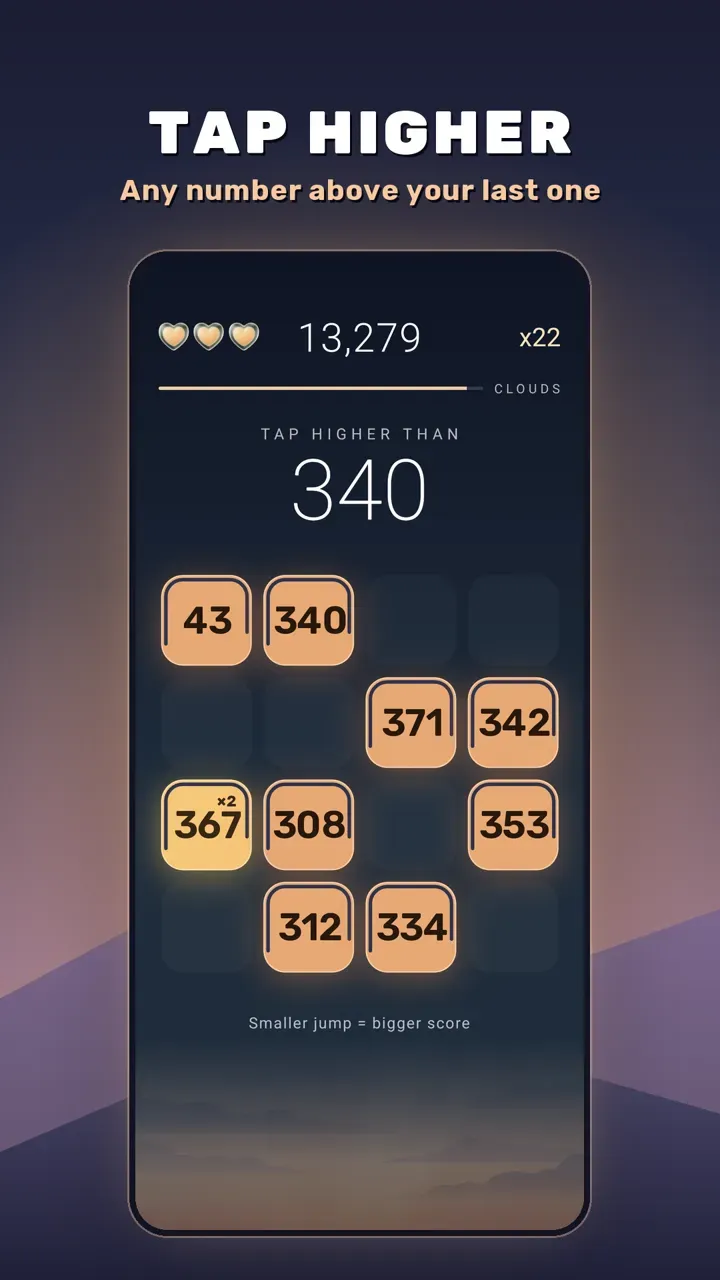
In this actual game screen, 342 is the closest visible number above 340. The smaller tiles 334 and 340 do not satisfy “higher than 340.”
Why choosing the same gap can earn different points
The base jump score compares your chosen gap with the best available gap on that wave. It is not simply a fixed reward for tapping a particular number.
In the standard scoring rules, the jump component starts from 100 for the closest choice. Other choices scale by the ratio between the best gap and the chosen gap, with a minimum jump score of 10. In the 12→13, 18 or 25 example, the jump components are 100, 17 and 10 respectively, before the other multipliers.
Those numbers explain the rule; they are not a promise that the final points shown on your next run will be 100. Speed, your existing combo, special tiles and mode modifiers can change the final award. A gold tile, for example, adds its own multiplier.
Balance accuracy, speed and combo
A fast response can multiply the score, while successful taps build combo. Selecting the closest valid number gives a larger combo increase than an ordinary valid choice under the standard rules.
A mistake normally breaks combo and can cost a heart, unless an applicable protection absorbs it. That makes accuracy valuable beyond the points on a single tile. A rushed invalid tap can interrupt the run you have been building.
Practise in this order:
- Remember the number you must beat.
- Rule out equal and lower numbers.
- Find the closest higher option you can identify.
- Tap while there is time, then read the new target.
If the timer is nearly gone and you have found a valid choice, waiting indefinitely for a better one is not useful. You are balancing the value of a smaller gap with the risk of a timeout. Build speed through repeated comparisons rather than blind tapping.
Read the rule when the mode changes
“Tap a higher number” describes the standard climb, but special challenges can change what you are being asked to do. The game supports variations such as a downward direction, odd/even restrictions and arithmetic labels.
Read the instruction for the run you are in. A habit learned for higher numbers can become a mistake when a challenge asks for lower numbers or restricts which values count. For arithmetic tiles, compare the result of the expression with the target rather than reacting to the largest printed digit.
This is also why a scoring example from the standard climb should not be treated as a universal rule for every event.
Which mode should a beginner use?
The game includes an endless climb, Daily Climb, weekly events and 72 handcrafted levels. Start with a mode whose instruction you understand, and practise the same comparison habit for a few runs.
Levels give you a defined goal; read that goal before assuming a high score is the only objective. The endless climb lets you practise keeping a run going as the waves develop. Daily and weekly challenges offer another reason to return once the basic rule feels natural.
The browser version is a quick way to try the core idea. The modes above are in the Android and iPhone apps; the game page lists everything they include.
Common mistakes and how to fix them
Picking the largest valid number. Compare gaps. If the target is 340 and 342 is available, 371 is not a better jump just because it is larger.
Forgetting that equality is invalid. “Higher than” means greater than, not greater than or equal to.
Chasing speed before accuracy. First learn to recognise valid choices. Speed bonuses are not useful if you keep breaking the run with invalid taps.
Ignoring a challenge’s instruction. Check direction, restrictions and labels when entering a different mode.
Questions about practice and online play
Does the game work offline?
Yes, it supports offline play. Online leaderboards and friend challenges need a connection; playing offline does not make those services available.
Can I watch the rule before playing?
The official trailer and Smallest jump wins short show the comparison in motion.