Heirlines heirs: how the family story carries on
Heirlines lets you continue as a living member of your character’s family after a death. The game offers eligible descendants first, then nieces and nephews, then siblings. A positive estate can be shared among family members, so choosing the next character does not automatically give them all the money.
This guide explains who appears, how to read the inheritance, and what changes when you begin the next life.
Who can you play as next?
The game checks living relatives in this order:
| First group with an eligible relative | Who can appear |
|---|---|
| 1 | Children and grandchildren |
| 2, if group 1 is empty | Nieces and nephews |
| 3, if groups 1 and 2 are empty | Brothers and sisters |
The order matters. If a living child or grandchild is available, a sibling does not become an alternative simply because you prefer their circumstances. The eligible group depends on the family at the end of this particular life.
If no eligible family member is alive, there is no heir to carry on as. Generational play depends on the family that developed during the story; it is not an automatic reset with a newly invented relative.
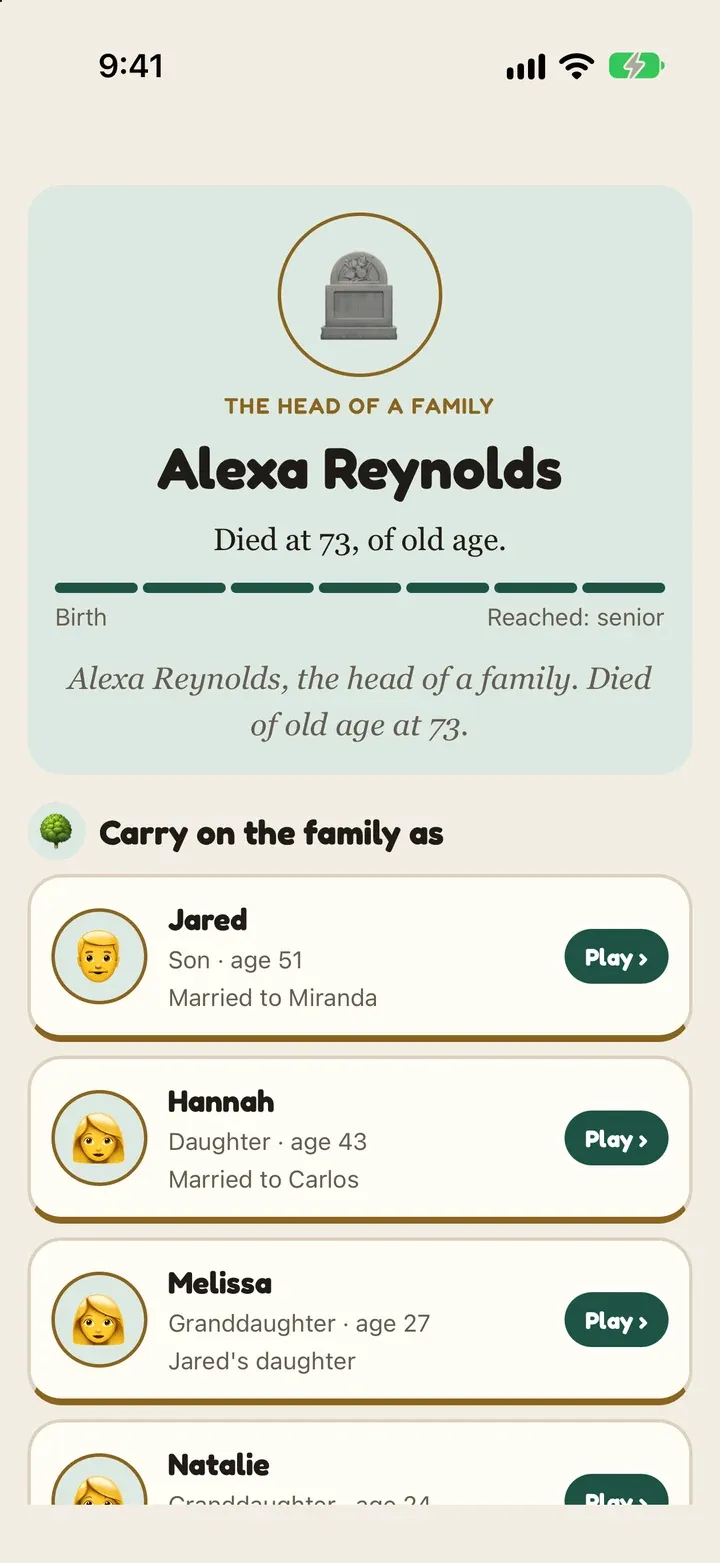
The actual heir-selection screen shows each candidate’s relationship, age and household information.
A worked family example
Suppose your character dies with a living daughter, a living grandson and a living brother. The daughter and grandson belong to the first eligible group. The brother belongs to the last group, so he is not offered while eligible descendants exist.
Now suppose a different character has no living children or grandchildren but does have a niece and a sister. The niece belongs to the next group the game checks. If no eligible niece or nephew survives either, the sister can become a candidate.
These are examples of the selection order. The names, ages and family you see will come from your own game.
Does the heir get the entire estate?
No. The game first works out the positive cash estate, applies the era’s inheritance tax, and divides what remains among the relevant living family members. An eligible child takes a share; a grandchild’s place in the distribution depends on whether their parent is still alive. The chosen heir is included in the sharing calculation.
For example, suppose the amount available after any tax is 90,000 and there are 3 equal shares. Each share is 30,000. Selecting 1 of those people as your playable heir does not turn their share into 90,000.
This arithmetic example illustrates sharing. It is not a claim that every life uses the same tax rate or has 3 beneficiaries. Read the handover messages for the actual estate, tax and share in your story.
What happens to a home and debt?
The family home carries into the next life, including payments still owed on it. Check the home’s payment situation as well as the cash your heir receives. Inheriting a home does not mean that all its remaining costs have disappeared.
A negative cash balance is treated differently: the game does not turn it into a negative cash inheritance for the heir. When the estate has nothing positive to distribute, the handover says there is nothing to inherit. That is separate from the remaining payments on an inherited home.
The practical lesson is to read the handover in parts: cash received, home received and ongoing commitments. A single wealth figure does not tell the whole story.
Does an heir start as a baby?
No. You continue at that person’s current age. An adult heir may already be working, married or raising children. Their relationships are presented from their own position in the family.
Before advancing a year, check:
- Age: how much of this person’s life has already happened?
- Household: do they have a partner or children?
- Work: are they in a job or between jobs?
- Money and home: what did the handover actually leave them?
- Dream: what direction does this particular life have?
A younger heir is not automatically the better choice. A different age or household gives you a different story to continue. Choose with the information shown, rather than assuming your old character’s work and circumstances have been copied over.
Heirs and second chances are different
An heir continues the family after the death. A second chance, when available, returns to the start of the fatal year so you can play that year again. Each life has a maximum of 3 second chances; a new heir has their own allowance.
You do not need the Heirloom to play as an heir. In the free game, the first second chance in a life is free and the next 2 use optional reward ads. The Heirloom removes the ad step, while the limit stays at 3.
Common inheritance misunderstandings
“I chose my child, so all the money should be theirs.” The playable heir can still share the estate with other family members.
“My brother is alive, so I can always choose him.” Descendants and then nieces or nephews take priority over siblings in the candidate selection.
“Buying the Heirloom unlocks the family line.” Generational play is already free. See the Heirloom comparison.
Start with the first-life guide if you are new, or get Heirlines to begin a family story.